


Powering progress responsibly
At Intercel, we believe that powering the future goes hand in hand with protecting it. Our commitment to sustainability extends beyond our products. It shapes how we operate, how we source, and how we treat people and the planet.
We take responsibility across the entire value chain: from the selection of raw materials and the transparency of our suppliers to safe production processes, recycling, and compliance with international standards.
Why our sustainability and compliance policies matter for you
Our Sustainability and compliance activities are crucial they give our clients confidence and peace of mind in an increasingly complex regulatory landscape. By proactively managing topics such as ESG performance, submitting CDP disclosures, preparing vSME sustainability reports, and ensuring full compliance with the EU Battery Regulation, the manufacturer reduces risk and administrative burden for its customers. Clients can trust that the products they use meet strict environmental and social standards, support their own reporting obligations, and align with future-proof sustainability requirements, allowing them to focus on their core business without worrying about hidden compliance gaps.
EcoVadis Gold Medal
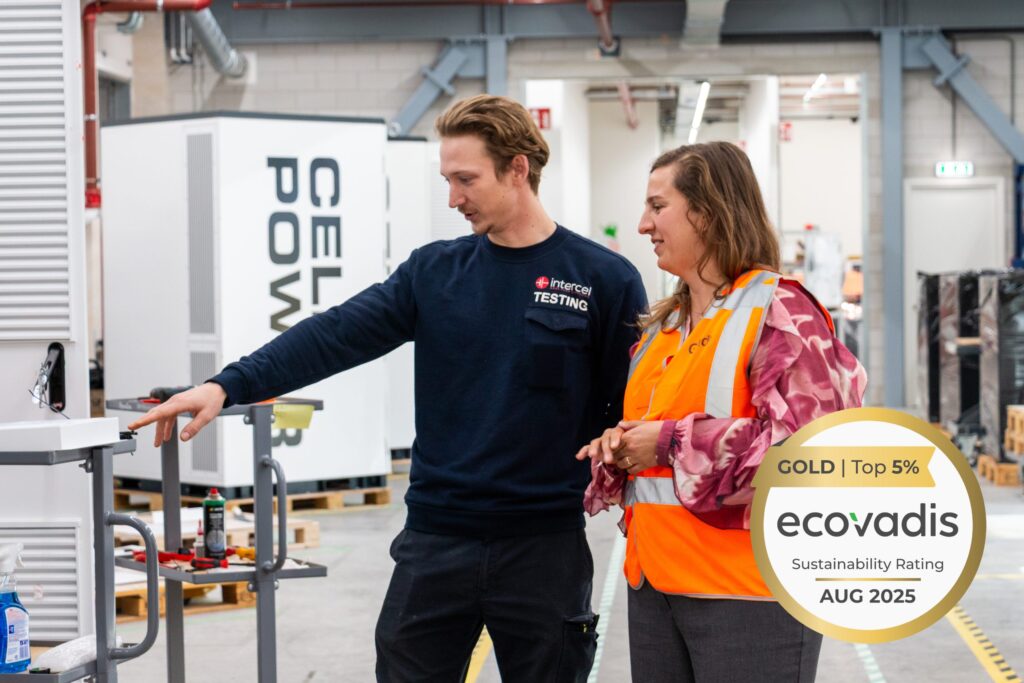
In August 2025, Intercel Group was awarded the EcoVadis Gold Medal, placing us among the top 5% of companies worldwide in sustainability performance. This recognition reflects our continuous efforts in the areas of environment, labor & human rights, ethics, and sustainable procurement and confirms that our actions match our words.
We are proud of this achievement, but it is only a milestone. Not the finish line. Every day, we continue to improve our operations and collaborate with partners who share our commitment to a cleaner, safer, and more transparent energy future.
Committed to a sustainable future
Much of our business is focused on the energy transition. For example, Intercel Electrification aims to accelerate the transition from fossil fuel use of mobile machinery to electricity by producing robust and technologically advanced batteries. And Intercel Storage aims to make the renewable energy resources needed available at all times by providing high-quality energy storage systems.
Regardless, we as Intercel are caught up in the energy transition and with it the transition to a sustainable future. This makes us even more aware that we must make choices responsibly and that a long-term sustainability strategy is important. Only in this way can we safeguard not only our own but also the needs of future generations.

Sustainability at our core
Battery technologies
With commitment to a sustainable future, it is important that we identify the complete life cycle stages of our products as best we can and make them sustainable wherever possible.
Our battery’s life begins with the gathering of raw materials and the making of battery cells. Although this life stage is outside the direct scope of Intercel ‘s business processes, we can influence this life stage by making the right choices. In the battery industry, LFP (main raw materials: lithium, iron and phosphate) and NMC (main raw materials: nickel, manganese and cobalt) are two common lithium battery technologies. The extraction of cobalt is often done in unethical ways. In addition, the service life of LFP battery cells is much longer. Consequently, we use almost only LFP battery cells in the lithium batteries and energy solutions we supply. We are also trying to offer a more sustainable range of our lead batteries. The Lead Carbon batteries are a good example of this due to their extended service life.
Sustainability within Intercel’s business processes
In addition to choosing certain battery technologies, we at Intercel have an impact on the environment through the design of our business processes. Our energy consumption plays an important role in this. We have made this more sustainable by installing solar panels on our business premises, using an energy storage system at the new production center and installing a heat pump. Half of our premises are already off gas. We are also trying to make transport associated with our business processes as sustainable as possible. For example, we limit air travel and most of our vehicle fleet is electric.
The “end” of life cycles
Doing business in a sustainable way also means that as a company we take responsibility for the products we supply and think about what happens to them at the end of their useful life. Intercel is affiliated with Stichting Open (formerly Stibat), which, among other things, promotes the integrality of the recycling process. Lead batteries can be recycled; up to 99% of the materials can be recovered in this process. With lithium batteries, however, this percentage is lower and, for the time being, a lot of energy is lost due to the high temperatures required to recycle the cells. It is therefore interesting to investigate how these cells can be more highly recycled.
Explore all battery technologies
Discover the different battery technologies and where each truly powers ahead.

A sustainable future
When it comes to sustainability, there is always room for improvement. That is why we are far from finished. For example, we also want to:
- Gain full insight in the raw materials due diligence and carbon footprint of our products. Batteries are generally carbon heavy products, so based on these insights, Intercel can determine where further carbon reduction can take place.
- Making our other offices more sustainable. Our new office and production center in Haarlem are already owners of a A+++++ energy label.
- Electric commercial vehicles for our service fleet (when available for heavy loads).
- Map the ESG values of all our customers, so please come to us with your challenges and where we can help. Chances are, we already align with your goals and ambitions!
In addition, we will investigate what Intercel can do with the batteries that will be returned from excavators, light-EVs, etc. in a few years. Possibly these can be reused in energy storage systems, for example. However, due to the long service life of the LFP cells, the batteries we supplied are still in use.
Thanks to the industry we are in, we consider ourselves an impactful and worthy player for the energy transition. For over 40 years we have been mobilizing people and products in the health care industry, in construction for e.g. aerial work platforms and other industrial applications, and making sure there is backup power for telecom and hospitals. The last 6 years we have also been committed to creating solutions for grid congestion challenges and the energy grid. We have already been able to make a lot of impact and we are very proud of it.
Stay powered with The Current
Subscribe to our digital journal The Current and stay informed about the latest battery innovations, events, market developments, and real-world use cases.